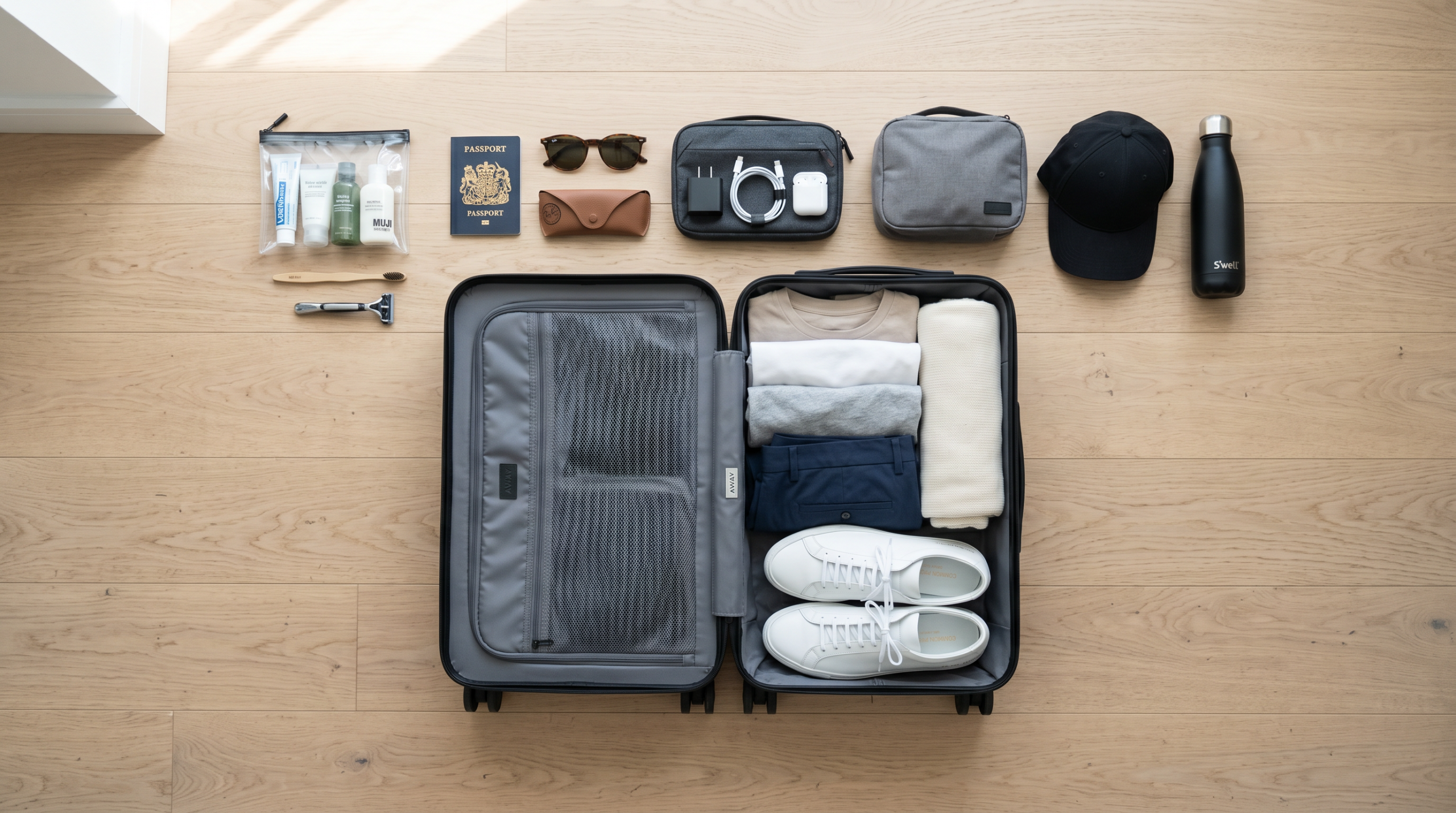
A quick framing note. This guide assumes a 7-day trip in moderate climate where laundry is available at least once during the trip, you’re staying somewhere with basic amenities, and you don’t need specialized gear for activities like serious hiking, scuba, or formal events. Trips with very specific equipment needs (a wedding tuxedo, ski gear, professional photography equipment) require their own approach. For most leisure and business travel — which is most travel — this framework works.
Step One: Pick the Right Bag
The wrong bag makes carry-on travel painful regardless of how well you pack. The right bag makes it easy. A few things matter more than the brand or the price.
Size compliance. Most U.S. airlines allow carry-on bags up to 22 × 14 × 9 inches (56 × 36 × 23 cm), including wheels and handles. International airlines, especially budget carriers in Europe and Asia, often allow smaller dimensions — sometimes 21.5 × 13.5 × 8 inches or less. If you fly mostly U.S. airlines, a 22-inch bag is the standard. If you fly internationally or on budget airlines regularly, a slightly smaller bag (around 20 inches) avoids the risk of a forced gate-check.
Soft-sided vs hard-shell. Soft-sided bags can squeeze into tight overhead bins and are lighter, but offer less protection for fragile contents. Hard-shell bags protect contents better and are easier to clean but are less flexible in oversized-sized bin situations. For most carry-on-only travelers, soft-sided wins; for travelers with cameras or fragile gifts, hard-shell.
Wheels matter. Spinner wheels (four-wheel, 360°) are easier in airports but can roll away on slopes. In-line wheels (two-wheel) are sturdier and handle uneven sidewalks better — useful for European cobblestones or developing-country streets. Pick based on where you actually travel most.
Bag weight matters. A bag that weighs 9 lbs empty leaves you only 11-13 lbs of useful capacity (most airlines cap carry-ons at 22 lbs / 10 kg for international flights). A bag weighing 5-6 lbs empty gives you significantly more room for actual stuff. Bag weight is one of the most underrated specs.
Plus a personal item. Almost all airlines also allow a personal item (small backpack, tote, or laptop bag) in addition to the carry-on. Use this. Your tech, books, snacks, and items you’ll want during the flight go here. It nearly doubles your effective capacity.
Step Two: The Capsule Wardrobe
Clothing takes up the most space in any bag, so the wardrobe is where almost all space efficiency lives. The principle: a small collection of pieces that all work together, so a few items produce many outfits. The fancy term is “capsule wardrobe”; the practical version is “everything must work with everything else.”
For a 7-day moderate-climate trip, this is a workable baseline:
A 7-Day Capsule Wardrobe
2 pairs of pants/bottoms. One darker, one lighter or different style. Both should work with every top.
4-5 tops. Mix of t-shirts and longer-sleeved or button-down options. Pick a coherent color palette (e.g., navy, white, gray, black, one accent color) so they all combine.
1 sweater or light jacket. Even in warm weather, useful for AC in restaurants or planes.
1 nicer outfit. If your trip includes dinners out or special events. Usually folds into one of the bottoms + a slightly nicer top.
5-7 underwear, 5-7 pairs socks. These compress to almost nothing.
Sleepwear. A t-shirt and shorts, or whatever you actually sleep in.
2 pairs of shoes maximum. One pair you wear on the plane (your bulkiest), one in the bag. A walking sneaker plus a slightly dressier pair handles most situations.
Swimsuit (if relevant). Takes essentially no space.
That’s it. The whole list fits in roughly half a carry-on, leaving room for everything else. The math: with 2 bottoms and 5 tops in a coordinated palette, you have 10 different outfits — more than enough for 7 days, even if you wear two outfits per day.
The color rule. Sticking to a base palette of 2-3 neutral colors plus 1-2 accents lets every piece pair with every other piece. A wardrobe of navy, gray, and white tops with khaki and dark jeans bottoms produces 10 outfits from 7 pieces. Add one bright accent color (a single red shirt, a patterned scarf) and you have visual variety without the volume.
Pick fabrics that travel well. Merino wool t-shirts can be worn multiple times without smelling. Quick-dry technical fabrics rinse in a sink and air-dry overnight. Wrinkle-resistant synthetics or wool blends survive packing. Cotton is comfortable but wrinkles, takes longer to dry, and shows wear faster. The fabric of your travel wardrobe matters more than the brand.
Step Three: Toiletries and TSA Rules
Toiletries are the second-biggest packing category and the most regulated. The TSA’s 3-1-1 rule is widely repeated but often misunderstood, so worth getting right.
The 3-1-1 rule: Each liquid, gel, aerosol, cream, or paste container must be 3.4 ounces (100 ml) or smaller. All containers must fit inside one clear, quart-sized, resealable plastic bag. One bag per passenger.
A few details that trip people up:
The container size, not the amount. A 6-ounce bottle with only 1 ounce of shampoo left will still be confiscated. The container itself must be 3.4 oz or smaller. This single misunderstanding causes more lost products at checkpoints than anything else.
What counts as “liquid.” The TSA category is broader than people think. Toothpaste, sunscreen, deodorant (the gel/aerosol kinds), peanut butter, salsa, lip gloss, snow globes — all count. Solid deodorant, bar soap, solid shampoo bars, and solid lipsticks don’t count and can travel separately.
Exemptions exist. Prescription medications (especially liquids) can exceed 3.4 oz; declare them at security. Baby formula, breast milk, and toddler drinks are exempt from the size limit. Contact lens solution is classified as a medical liquid and similar exemptions may apply, but rules vary — declare it if it’s over the limit.
What to actually pack in a quart bag for a week:
Travel-size shampoo/conditioner combo (or solid bars). Travel-size body wash (or bar soap). Toothpaste. Deodorant (solid travels best). Sunscreen if relevant. Moisturizer or face cream. Any liquid skincare you actually use. Most people overpack toiletries by 3-4x what they actually need in a week.
What to leave home: Full-size anything; products you “might use”; hair products you don’t use at home; the third moisturizer. If you wouldn’t reach for it on day 4 at home, you won’t reach for it on day 4 of a trip.
Most hotels provide basics. Shampoo, conditioner, soap, and body wash come standard at most hotels. If you’re flexible about brand, you can skip these in your bag entirely. Worth checking with your accommodation before packing.
Step Four: Electronics and the Battery Rules
Modern travelers carry significant electronics: phone, laptop, charger cables, power adapter, possibly an e-reader, camera, headphones, portable charger. The aviation rules around batteries are stricter than the rules around almost anything else, and getting them wrong can mean confiscation or worse.
The critical rule: spare (uninstalled) lithium-ion and lithium metal batteries must travel in carry-on bags only — never in checked baggage. This includes power banks, portable chargers, and spare phone or camera batteries. According to FAA’s PackSafe guidance on lithium batteries, spare lithium batteries can catch fire if damaged or short-circuited, and the risk is mitigated only if cabin crew and passengers can respond. If your carry-on is gate-checked or plane-side checked, you must remove spare batteries and keep them with you.
Watt-hour limits. The FAA’s official guidance for airline passengers states that rechargeable lithium-ion batteries up to 100 watt-hours (Wh) are allowed on passenger aircraft. Batteries from 101-160 Wh require airline approval. Batteries over 160 Wh are forbidden. Most consumer electronics — phones, tablets, laptops, typical power banks — are well under 100 Wh. Larger power banks marketed for camping or laptop charging may exceed limits, so check the Wh rating before traveling.
Protect battery terminals. The FAA specifically requires battery terminals to be protected from short circuits — keep batteries in original packaging, in protective cases, or with terminals taped over. Loose batteries in a bag with metal objects (keys, coins) can short-circuit, overheat, and start fires.
Damaged or recalled batteries cannot fly. Both the FAA and airlines prohibit damaged, defective, or recalled lithium batteries in any baggage. If your laptop or power bank has been recalled, follow the manufacturer’s instructions for disposal — don’t try to fly with it.
What this means for a 7-day trip:
Your phone, laptop, e-reader, camera, etc. with batteries installed: travel in your carry-on, fine, no special handling. Your power bank or portable charger: carry-on only, terminals protected, under 100 Wh. Spare camera batteries: carry-on only, in original packaging or with terminals taped.
The electronics packing list for a week:
Phone + charger. Laptop or tablet + charger (only if you genuinely need both). One universal cable that works for as many devices as possible. Power bank (under 100 Wh, in carry-on). Headphones. Power adapter for your destination country (if international). E-reader (optional; saves carrying books).
What you don’t need: multiple chargers for the same device, “just in case” cables for devices you don’t have, a power strip (most aren’t allowed at security and aren’t needed anyway), an electric toothbrush charger (use a manual toothbrush for a week).
Step Five: How to Actually Pack the Bag
The same items can fit easily or with great difficulty depending on how you pack. A few techniques produce dramatically more usable space.
Rolling vs. folding. Rolling clothes generally takes less space than folding for casual items (t-shirts, knits, socks, underwear). Folding works better for items that wrinkle (button-down shirts, dress pants). A mix produces the best result.
Packing cubes. Inexpensive zippered fabric organizers (around $20 for a set of 3-4) make a real difference. They compress clothes, keep categories separate, and make unpacking trivial. A “tops” cube, “bottoms” cube, “underwear/socks” cube, and “toiletries” cube means everything has a home and the bag stays organized through 7 days of use.
Shoes go in shoe bags or plastic bags. Shoes that have walked outside are dirty even if they don’t look it. A simple drawstring bag or plastic shopping bag keeps clean clothes from touching shoe soles.
Heavy items at the bottom near the wheels. When the bag is rolling upright, you want the weight closer to the wheels — easier to maneuver, less likely to tip over. Shoes, books, and toiletries near the wheels; lighter clothing on top.
Fill the gaps. Socks and underwear can fill the inside of shoes, the corners of the bag, the gaps around hard items. No wasted space.
The personal item carries the dense stuff. Books, laptop, electronics, the quart bag of liquids, snacks. This keeps your carry-on lighter and the personal item (which usually has no weight limit) does the heavy lifting.
The Complete Pack List for 7 Days
Things People Pack and Shouldn’t
“In case it gets cold/hot” outfits. Check the weather forecast for your destination. If it’s 75°F for the entire week, don’t pack a sweater for the “what if it’s cold” possibility. If a single layer covers all forecast scenarios, that’s all you need.
Three pairs of jeans. One pair is fine for a week. Two pairs is a luxury, not a necessity. Jeans don’t need washing between every wear; they last several days easily.
Five “going out” outfits. For most trips, one nicer outfit handles every restaurant or evening situation. If your trip genuinely includes multiple formal events, that’s its own thing. Otherwise, one is enough.
Books in physical form. A single paperback is fine; three is excessive. An e-reader holds an unlimited library at the weight of a thin paperback.
Full-size toiletries. A full-size bottle of shampoo lasts you 6 months at home. You don’t need it for 7 days, and TSA will take it anyway.
“Just in case” medications you don’t actually use. Bring prescriptions you take daily, plus a small kit with the basics (pain reliever, antihistamine, bandages, stomach medication). Don’t pack every drug in your medicine cabinet “just in case.”
Excessive cables. One cable per device family (USB-C for phone/laptop, separate cable for older device if needed). Not three of the same cable. Not adapters you’ll never use.
Beach towel. Most hotels and rentals provide towels. If you’re going somewhere with a beach and no towel access, a quick-dry travel towel folds to the size of a small book. A full beach towel is dead weight.
Doing Laundry on the Road
The single habit that makes carry-on travel possible for trips longer than a weekend is doing some laundry along the way. It doesn’t require finding a laundromat.
The hotel sink method. Most synthetic and merino wool clothes can be rinsed in a hotel sink with a small amount of soap (the hotel’s bar soap or a tiny bottle of laundry detergent works), wrung out gently, and air-dried overnight on a hanger. Underwear and socks especially are designed for this. By day 4 of a trip, doing 10 minutes of sink laundry effectively doubles your wardrobe.
Hotel or hostel laundry services. Many hotels offer wash-and-fold service. It’s expensive at high-end hotels but reasonable at budget hotels and hostels. A single mid-trip laundry session resets your entire wardrobe for the rest of the trip.
Laundromats. In most cities, you can find a coin-op or wash-and-fold laundromat. Costs roughly $10-15 for a full load. Worth it once on a 7-day trip; not worth doing twice.
Pack with laundry in mind. Fabrics that dry overnight (synthetics, merino wool, light cotton) are vastly easier to wash on the road than fabrics that take 2-3 days to dry (heavy cotton, denim). The fabric choice in your travel wardrobe directly enables in-trip laundry.
Documents, Money, and Security
Documents. Passport (if international), driver’s license/ID, credit cards, debit card. Bring two credit cards from different banks in case one is blocked. Photocopy or photograph everything important and store the copies separately from the originals — losing a wallet with all your documents and copies in it is much worse than losing a wallet with originals while the copies are at the hotel.
Cash and cards. Most places accept credit cards now, but some smaller vendors, taxis in some countries, and emergencies require cash. Get some local currency from an ATM at the destination airport. Don’t carry large amounts of cash — split what you have across your bag and your person so a single theft doesn’t take everything.
Notify your bank. Many banks now don’t require travel notifications, but checking is free. Without notification, foreign or unusual charges may get flagged and your card blocked — strand-you-at-checkout territory.
Scam awareness. The FTC’s guidance on avoiding travel scams emphasizes using credit cards (which offer fraud protection) over debit cards, cash, or wire transfers for travel-related purchases. Especially in-destination tour bookings, restaurant deals, and “special” experiences that pop up on the street — pay by card when possible.
Common Mistakes to Avoid
Packing for the trip you imagine, not the trip you’ll have. Most people pack for an idealized version of their trip where they wear every outfit, take an active hike, attend two dressy dinners, and lounge by the pool — the items needed for all of those activities add up to a packed suitcase that produces a stressed traveler. Pack for the realistic trip, plus one small flex item for the unexpected.
Packing the night before. Last-minute packing produces “in case” items, forgotten essentials, and an overstuffed bag. Pack 2-3 days before. Live with what’s in the bag — meaning, wear nothing else for those 2-3 days at home, which reveals what’s actually missing or what’s never used.
Not weighing the bag. Most airlines have a carry-on weight limit (especially international: 22 lbs / 10 kg is common). A bag at the size limit but over the weight limit gets gate-checked. A bathroom scale at home prevents this surprise at the airport.
Buying packing organizers without packing first. Specialized cubes, pouches, and compression bags only help if you know what you’re packing. Start with a normal pack; add specialty organizers later if a specific problem emerges.
Ignoring the airline’s carry-on rules. Each airline has slightly different size, weight, and personal-item rules. Check before you go, especially for budget airlines that enforce strictly and charge significant fees for non-compliance at the gate.
Treating “carry-on only” as deprivation. If the act of packing light feels like cutting away things you wanted to bring, the trip starts on a bad note. Reframe: carry-on travel is a freedom, not a constraint. No checked bag fees, no waiting at baggage claim, no risk of lost luggage, no aching back from oversized bags. The “less” is the point.
One Bag, Seven Days, No Drama
Packing a week into a carry-on isn’t about miniaturizing your life. It’s about realizing how little of what you typically pack you actually use. The first time you do it, the bag will feel suspiciously empty and you’ll worry you’ve forgotten something. By day three of the trip, you’ll wonder why you ever traveled differently. The 80-20 rule applies: 20% of what people typically pack does 80% of the real work. The rest is anxiety in clothing form.
The core habits: a coordinated capsule wardrobe of pieces that all work together, toiletries within the 3-1-1 rule, electronics that comply with TSA and FAA battery rules, packing cubes for organization, and willingness to do 10 minutes of sink laundry mid-trip. None of these is difficult. Together they make the difference between dragging a heavy suitcase through cobblestone streets and walking off the plane with your one bag and skipping baggage claim entirely.
Try it once on a short trip. Notice what you actually used, what you didn’t, and what was missing. By the third trip, you’ll have your personal version of this list dialed in. The carry-on becomes the default and the checked bag becomes the exception — reserved for genuinely specialized trips. That’s the goal.
This article is for general informational and educational purposes only. TSA and FAA regulations change periodically; airline carry-on size, weight, and personal-item rules vary by carrier and route. Check tsa.gov, faa.gov/hazmat/packsafe, and your specific airline’s current policies before traveling, especially for international flights, lithium battery limits, and any specialty items.
Leave a Reply